New York City’s Worst Highways Can Lead Somewhere Better
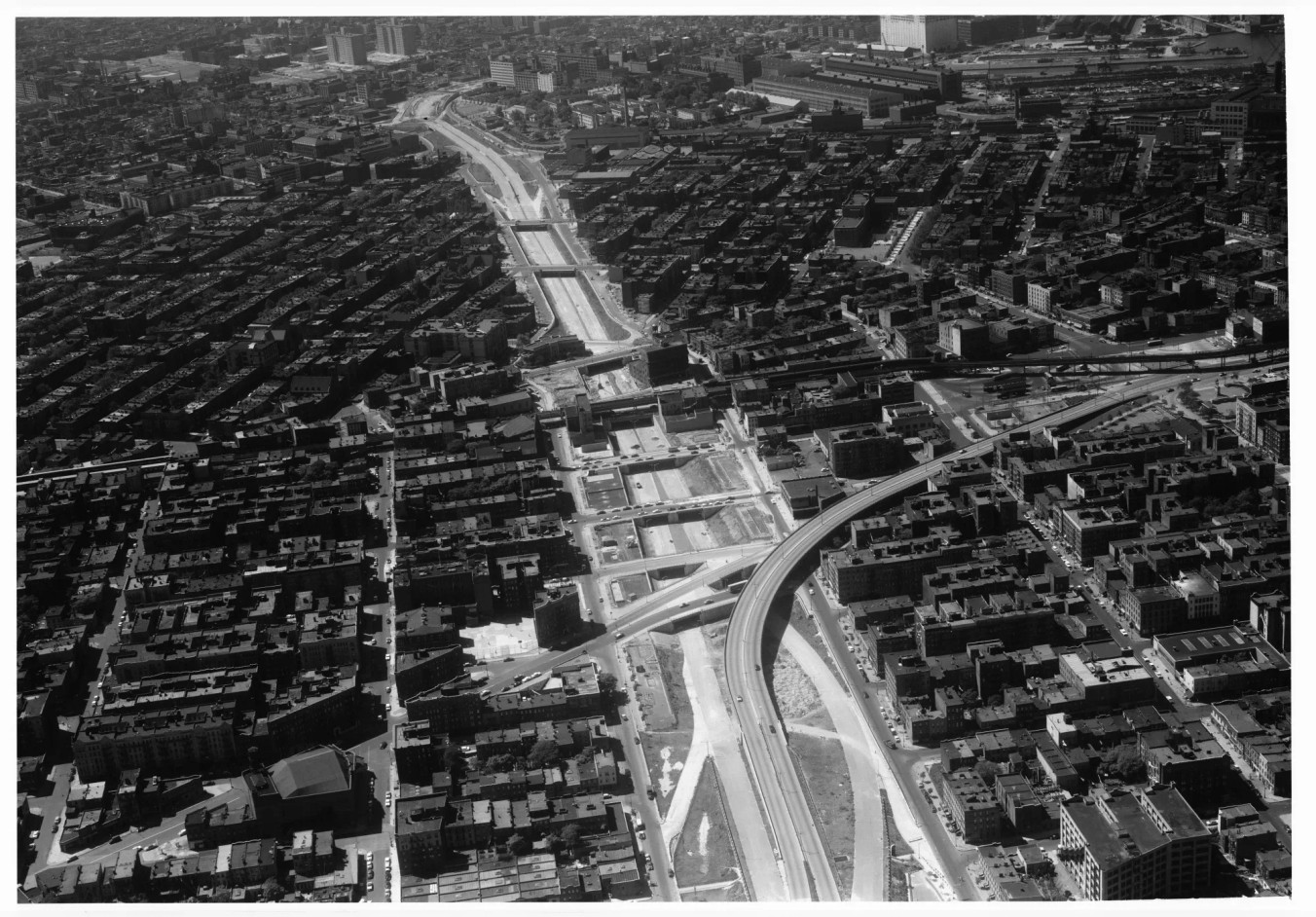
On a hot summer day last August, a crowd gathered in a small plaza opposite a playground in Brooklyn’s Williamsburg neighborhood. There, in an enclave known as “Los Sures” (or “Southside”), two parks are cleaved by the Roebling Street onramp, where a stream of cars and trucks enter a tangle of freeway connecting the bridge to the Brooklyn-Queens Expressway.
Maria Pulido-Velosa, a member of the community development organization El Puente, took the microphone and addressed the group. “Our young people here that are trying to play in the playground and hang out on this plaza are constantly overburdened by noise and air pollution,” she said. “We know that this is not the way that it has to be.”
El Puente, whose headquarters sit nearby, is part of the BQE Environmental Justice Coalition, a collection of community activists bound by their proximity to the 11-mile expressway. The predominantly Black and brown neighborhoods next to the BQE bear much of its costs. More than 40 playgrounds and neighborhood parks adjoin the highway, and air monitoring studiesreveal the heavy toll of air pollution. Asthma rates in Williamsburg are more than double the average in New York City.
When construction began on the BQE in 1937, it heralded a new era. Alongside the Cross Bronx Expressway and the 13 other New York City highways devised by famed planner Robert Moses, these roads became the design template for America’s new highway system, enshrined in the 1956 Federal Highway Act. To build them, authorities seized homes and razed neighborhoods, displacing thousands and pulsing traffic through the densest parts of the city.
But today, New York City’s expressways could emerge as a different kind of model, by putting communities at the center of the discussion about what should be done with this infrastructure.
The city’s highways have fallen into disrepair, with aging bridges, spalling pavement, corroding rebar and faulty joints — all made worse by the weight and volume of some of the most congested interstates in the US. Nationwide, nearly 40% of major roads are in poor condition.
Now we are at a crossroads. We could further entrench urban auto dependency for decades to come, patching up and even expanding the roadways that bring traffic congestion and air pollution to already-burdened neighborhoods. Or we could embrace a multimodal future benefiting community connection, public health and climate solutions.
In South Williamsburg, residents envision the latter. And they are not alone.
Expressways Reimagined
New Yorkers have fought freeways for decades. In the early 1970s, Bronx organizers successfully blocked a Moses-planned extension of the Sheridan Expressway; today, a large stone column for the never-completed roadway stands in the Bronx River to mark their victory. In 2019 the community won a battle to transform the little-used highway stub into a boulevard.
Examples of such modern urban highway reforms abound upstate: A decade ago, Rochester’s Inner Loop was closed to traffic and filled in with residential and retail development; in Syracuse, the I-81 viaduct is being replaced with a “community grid” of tree-lined parks and walkable, bikeable streets. In Buffalo, those who live along the Kensington Expressway are also pushing for its full removal. Most recently, a planned expansion of Route 17 in the Catskills was stalled.
Just as the interstates were built as an interlinking system, they are now being fought by a network of communities most affected by them — a coalition of coalitions that demand a say in what comes next.
Community-led planning efforts show how residents can envision the transformation of the highways in their neighborhoods. Nilka Martell, founding director of Loving the Bronx, helped to shape “Reimagine the Cross Bronx Expressway.” The study, supported by a $2 million federal grant under the Biden administration, engaged residents to explore solutions along the Cross Bronx corridor. It recommended long-term infrastructure changes like capping the trenched portions of the highway to create parks and open space above.
In South Williamsburg, El Puente’s activists stood together with members of the Stop the Cross Bronx Expansion Coalition, led by the Bronx River Alliance. That group has been fighting a New York State Department of Transportation proposal to build a “traffic diversion structure,” expanding the highway by adding several lanes over Starlight Park and the Bronx River.
Their efforts mirror the ongoing conversation about covering over portions of the BQE, to help stitch the divided neighborhoods back together. In 2024, the New York City Department of Transportation released “BQE North & South,” a report that envisions nearly 30 projects along the span of the freeway. The city’s ability to change the BQE is limited, because the state owns all but the 1.5-mile triple-cantilevered stretch of the freeway in Brooklyn Heights. But the NYCDOT can alter land adjacent to the BQE.
To that end, NYCDOT provided funding to 18 community-based organizations, including El Puente, to engage locals. The process produced a range of short- and long-term fixes, including capping the BQE trench between Division Avenue and Borinquen Place to create “Marcy Green,” a park and playground connected with pedestrian, cycling and transit routes. Designed by architecture firm WXY, Marcy Green builds upon “BQ Green,” a community-led proposal advanced more than a decade ago that envisioned a 3.5 acre park, designed by Susannah Drake, over the highway.
While capping can have positive impacts in local communities, it will not limit the number of vehicles flowing through the neighborhood or fully mitigate their effects. Reducing traffic requires robust investment in public transportation — something that incoming mayor and Queens native Zohran Mamdani has recognized as a priority, and that New York City’s first-in-the-US congestion relief program now helps fund.
The CBE and BQE are also major freight corridors: During the pandemic, some 3.7 million packages were delivered daily to New Yorkers, most arriving in diesel trucks that emit some of the most harmful pollutants to human health. To reduce commercial traffic, the city’s Blue Highways initiative would shift some freight traffic to waterways while investing in waterfront communities like Red Hook and Hunts Point, where marine terminals are planned. These facilities could create thousands of jobs for New Yorkers and include hubs for micro-distribution, using e-bikes to make local deliveries on neighborhood streets.
State departments of transportation can also use their budgets to reduce vehicle traffic. The New York State Senate is considering a bill, advanced by New Yorkers For Transportation Equity, that aims to cut vehicle miles traveled statewide; if passed, it could provide further incentives to reimagine urban highways. Across the US, such state and local collaboration is essential, as the momentum of federal grants and other funds from the Biden era screeches to a halt under the Trump administration.
A Way Forward
After years of meetings, letters, and rallies, Bronx residents came out decisively against the CBE “traffic diversion.” Their resistance gained the support of local elected leaders and the attention of the state transportation department. Traveling from Albany, NY DOT commissioner Marie Therese Dominguez — the first Latina to run the department — spent time with the coalition and heard their concerns. “It was a huge accomplishment, to get the commissioner of a state agency to come down to the Bronx to have a dialogue with us,” Martell said. In a press release, Dominguez acknowledged that “the community made it clear that the use of a traffic diversion structure was a non-starter.”
This win shows that the biggest successes are not just the plans that have been drafted, but the process and leadership that have been created to advance them.
On that August afternoon in Los Sures, community members were asked to submit ideas for a corner of Roebling Street that may soon be cleared of cars — one of the near-term steps toward the BQE North & South vision. Nearly all participants transformed the parking space into a park, drawing trees, plants, vegetable gardens, benches, hopscotch courses and a soccer field. Some just wrote the words “jardines,” “flores,” or simply “no cars.” People sat at tables coloring green over the grey outlines of the freeway; others made seedballs loaded with native plants and took a stick to a truck-shaped BQE piñata.
“We are here so that we can collectively create something better that all of us can enjoy and afford,” said Pulido-Velosa.
Today, we have many of the pieces we need to create something better: strong coalitions, leaders willing to listen, and models of support for community-led initiatives. Lives are at stake with each mile paved, each trip in a private automobile, and each package delivered by a truck rattling down a freeway. Now we have an opportunity to do things differently, to see our failing infrastructure as an opportunity to generate equitable processes and create agency and capacity for communities that have borne decades of injustice. We can blame Robert Moses for creating these highway systems in our cities, but we can only blame ourselves for keeping them.
— Alison Sant is the author of From the Ground Up: Local Efforts to Create Resilient Cities and the forthcoming Streetlife: Transforming Our Largest Public Spaces into Places for People. She is a co-founder and partner in the Studio for Urban Projects.